Carers
Never Let Me GoCarers attend to donors through the organ-donation system, offering not only practical presence but also the emotional attention that can make recovery more bearable. Kathy H.’s nearly twelve years in the role show its particular demands: patience and judgment, attachment to the people in one’s care, and the strain of continuing to care within a system whose ultimate outcome cannot be changed.
Role and responsibilities
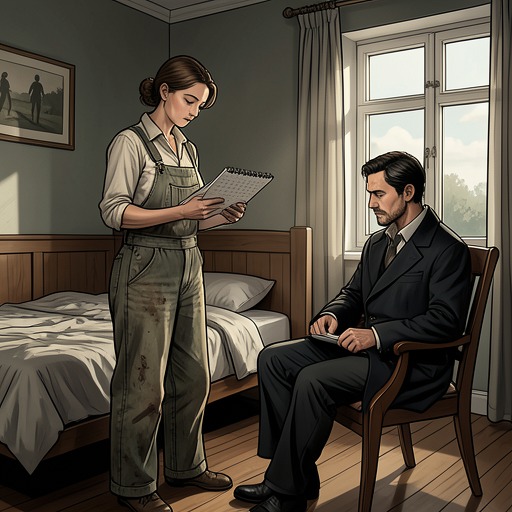
Kathy describes care as an adaptive practice rather than a uniform routine. She has learned when to stay and comfort a donor, when to give them space, when to listen, and when to answer distress with a brisker encouragement. Her donors have generally recovered better than expected, and few have been classified as agitated, even before their fourth donation. Kathy takes pride in this record, while recognizing that caring well depends on judgment about each person, not simply on remaining at a bedside.
The work consumes patience and energy. Kathy argues that carers are not machines and cannot sustain unlimited emotional effort; the ability to choose donors can therefore matter to whether a carer can keep working effectively. Her account makes the role’s emotional labor visible: the carer is expected to respond closely to donors’ needs, but that response is itself tiring. Doing the work well means remaining emotionally involved, not becoming immune to what donors experience.
Tenure and choice
At thirty-one, Kathy has already worked as a carer for more than eleven years and has been asked to continue for another eight months, which would bring her service to almost exactly twelve years. She does not treat this unusually long tenure as proof that she is better than other carers. Some capable carers have been told to stop after two or three years, while one she recalls continued for fourteen years despite being, in her judgment, ineffective. Kathy believes her work has pleased those responsible for it, but resists presenting herself as exceptional.
For the first six years of her career, Kathy was not allowed to choose whom she cared for; during the last six, she has been able to select donors. That discretion has prompted criticism. Other carers may see her as privileged because she has a car and bedsit and can choose, and some say she favors people from Hailsham or other privileged institutions. Kathy acknowledges that a preference for people from her own background is natural, but notes that she has also cared for donors raised in many kinds of places. By the time she finishes, she will have spent half her career without the privilege of choosing.
Care, memory, and attachment
Choosing donors has shaped Kathy’s personal life as well as her work. Ruth was only the third or fourth donor Kathy chose, and Ruth already had a carer assigned when Kathy arranged to take her on. When they met again at the Dover recovery centre, their differences did not disappear, but their shared childhood at Hailsham and the memories no one else could share gave them a bond. Kathy traces her later habit of seeking donors from her past, particularly from Hailsham, to that reunion. For her, the choice to care for familiar people is a way of recovering closeness after years apart.
The need for that connection becomes clearer as Kathy’s career proceeds. Fewer donors remain whom she remembers, and she has in practice been choosing less often. Caring without a deeper personal link is harder; although she expects to miss the work, she also feels that finishing at the end of the year is right. The role thus holds both attachment and loss: familiar donors give care an intimate meaning, while the dwindling number of those people makes continued service more difficult.
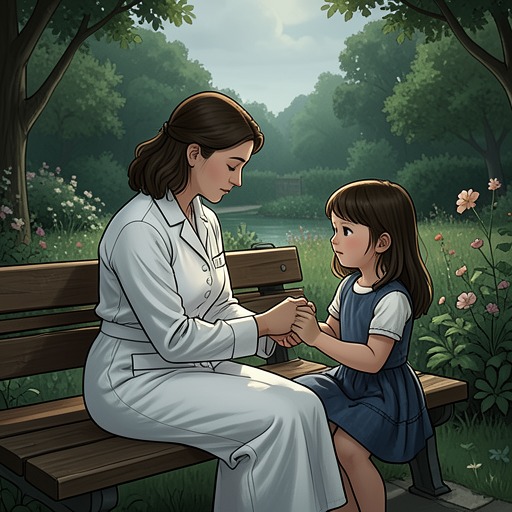
Kathy’s care for Ruth reaches beyond the formal span of a donor’s recovery. Three days after Ruth’s second donation, Kathy is allowed to sit with her in a hospital room. Ruth is conscious but largely inaccessible, and Kathy holds her hand, squeezing it when pain makes her twist away. During a brief moment of lucidity, Kathy understands Ruth’s unspoken wish that she become Tommy’s carer. She promises to do so as soon as she can. The promise turns professional assignment into a final act of friendship and gives Kathy a way to answer Ruth when conversation is no longer possible.
Limits of the role
The carers’ presence cannot remove the larger uncertainty surrounding donations. Kathy recalls that, after Miss Lucy told the students that their futures were set and that they would donate vital organs, Ruth later claimed Miss Lucy had also explained a sequence in which students first served as carers. Kathy is unsure that Miss Lucy actually said this: she suspects Miss Lucy began to explain more but stopped when the students’ confusion made the task impossible. The account reflects a wider condition in which students have been told about their fate without fully understanding it, including the place of care within that future.
That uncertainty returns when Tommy approaches his fourth donation. Donors may be treated with special respect at that stage, and doctors and nurses may greet them with smiles and handshakes, yet Tommy wonders whether anyone can be sure he will complete. Rumors imagine that a donor might remain conscious after a supposed completion, face further donations, and have no recovery centre, carer, or friend beside them. Kathy recognizes that even doctors may have no certain answer. She dismisses Tommy’s fear as baseless talk, then regrets that they both withdrew from the subject instead of discussing it. The episode marks the boundary of care: listening and reassurance can accompany a donor through fear, but a carer cannot guarantee what lies beyond the system’s known stages.
Tommy later asks whether Kathy ever tires of being a carer and wishes that her own notice would arrive. Kathy answers that good carers matter, while Tommy questions whether their care changes the eventual fact that donors will donate and complete. Their exchange exposes the role’s central contradiction. Carers can reduce isolation, help donors remain calm, and make painful moments more bearable; they cannot undo the institution’s purpose or make its ending certain. The distinction gives Kathy’s work its emotional weight: her care matters precisely within limits she cannot overcome.